Market Adaptive
Savings (MAS)
No-brainer Addon to your existing investments Investments that happen when markets undervalue, to capture volatility and higher growth, determined by our robustly tested models.
- One-time setup
- Keep your existing portfolio
- Higher than average ROI
MAS can execute automatically, or through notifications on chosen indices and funds.
Reach wealth goals faster.
Demonstrated MAS investments on Nifty50 index
Statistically 2–6% higher than avg XIRR of SIP in the same asset
Note: This is not an alternative to SIP, an additional corpus on top of it.
ROI
Investments range from ₹0 to your weekly max each week. On average, 30% of your max is saved (as of recent markets).
Swipe the table to see all three windows →
| Every three-year run since 2021typical — median of every rolling window | 2022 – 2024calendar window | 2023 – 2025calendar window | ||||
|---|---|---|---|---|---|---|
| Fixed | MAS | Fixed | MAS | Fixed | MAS | |
| Indices | ||||||
| Nifty 50 | 12.6% | 15.0% | 13.0% | 15.2% | 11.9% | 14.3% |
| Nifty Next 50 | 18.4% | 22.1% | 24.4% | 27.7% | 14.9% | 18.5% |
| Nifty Midcap 150 | 22.0% | 25.6% | 29.1% | 30.8% | 18.0% | 20.4% |
| Nifty Smallcap 250 | 20.7% | 27.4% | 31.5% | 35.3% | 12.9% | 18.8% |
| Funds — one per style, from India's five largest fund houses | ||||||
| HDFC Flexi Cap | 22.9% | 26.1% | 26.1% | 29.1% | 18.8% | 21.6% |
| SBI Large Cap | 14.1% | 16.1% | 15.7% | 17.1% | 12.9% | 14.8% |
| Nippon India Growth Mid Cap | 25.2% | 29.0% | 32.8% | 34.5% | 19.0% | 22.4% |
| Kotak Small Cap | 16.3% | 20.8% | 25.5% | 26.6% | 8.2% | 13.4% |
| ICICI Prudential Value | 21.5% | 23.5% | 23.5% | 26.0% | 18.6% | 20.1% |
Backtested on published historical NAVs. Live returns match out-of-sample results.
Ideal period: 1–5 years keeps capital productive, leading to faster-growing capital that can be rebalanced.
The most optimal solution on top of regular savings
Long-term mean reversion* for regular savings
Machine-learning ensemble models, trained on 18 years of data and tested on unseen and live periods. Made by humans, they take guesswork and emotion out of capturing savings opportunities for the long run.
*Mean reversion — the statistical tendency of an asset's price to drift back toward its long-term trend after moving away from it. Mean-reversion models measure how far an asset trades from that trend and invest more when it sits meaningfully below it, acting on the size of the gap rather than predicting short-term moves. A long-run tendency, not a certainty.
Putting it to work
SEBI Certified Research Analyst — secure and licensed
One-time Setup
- Pick index/funds and weekly limit
- NSE's KYC and mandate
Get market adaptive orders
with approval link in WhatsApp
View savings ROI
Performance dashboard, compare with fixed recurring savings
The research
Over very long windows (10+ years) the market's drift dominates — but on the horizons most savers actually target, the same money reaches a higher ROI faster.
More productive capital
The model's expanding XIRR on the Nifty 50 — last 1 year.
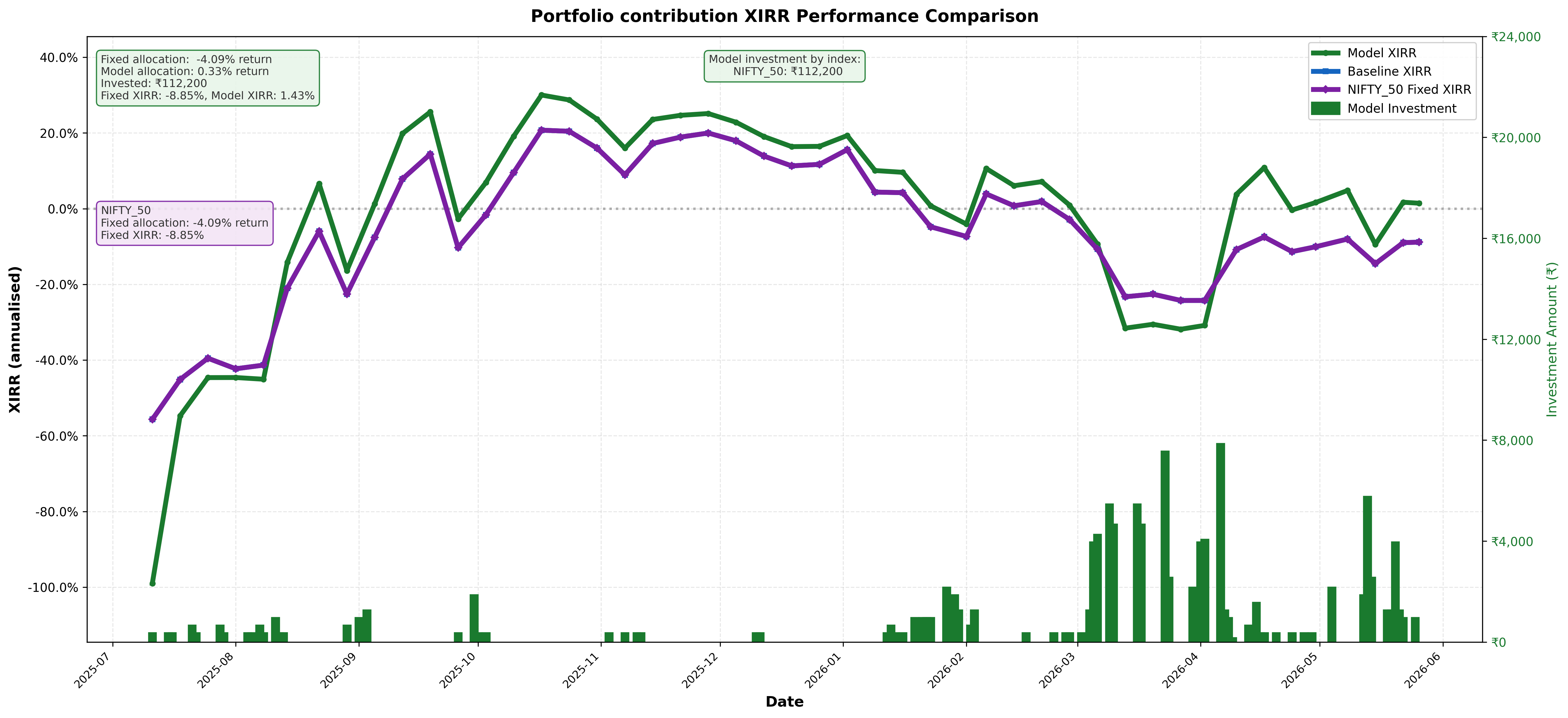
Model XIRR vs a fixed plan on the Nifty 50 — last 1 year, with the model's investments.
Bonus: Capital can be liquidated sooner
Since MAS investments occur at less downside, capital generates a reasonable ROI faster than average.
Up to ~50% sooner to reach 12% or higher returns
Over 95% of 1-year rolling windows tested, market-adaptive savings has higher ROI than fixed savings — add it on top of your existing savings as markets move.
A comparative illustration of how the overlay deploys capital — not a statement of returns, a performance record, or a guarantee. The edge narrows over very long windows as expected. Mutual fund investments are subject to market risks.
My clients want discipline without the drama. Rezz quietly turns volatility into value inside a limit they set — it does exactly what I'd advise, automatically, and they stay in control the whole way.
I don't have time to watch the market. I set a weekly cap once and Rezz handles the smart, boring part. Two-minute setup, then I forgot about it — in the best possible way.
I've onboarded clients on plenty of platforms. The fact that every debit is authorised by the investor on NSE's own pages makes Rezz an easy one for me to put my name behind.
The volatility-capture logic is exactly the kind of rules-based, value-led edge I'd build myself — except I don't have to. It's transparent, hard-capped, and it sticks to the plan when markets get noisy.
Questions, answered.
Who manages my money?
You do. Rezz Invest (a SEBI-Registered Research Analyst) provides research and recommendations. Every transaction is authorised by you on NSE's secure pages, and your investments are held in your own name.
How much does it cost?
Free for a limited time — ₹1,000/year. We'll notify you about any charges well before they begin.
Is my money at risk?
Your money is invested in mutual funds, so its value moves with the market — it can rise and fall. The model is built to turn volatility into an advantage — investing more when prices are lower — and to keep you in control with a weekly limit you set, though no approach can promise returns. We'd always suggest reading the scheme documents before you start.
How does the auto-debit work?
You set up an e-NACH mandate with a per-debit ceiling you choose. It only ever lets us request a debit up to that ceiling, and within your weekly limit — and each purchase still needs your approval.
Can I stop anytime?
Anytime. There's no lock-in. You can pause investing, change your weekly limit, or cancel whenever you want.
Ready to turn volatility into value?
Set a weekly limit, choose your funds, and let market-adaptive addon (MAS) save for you, at higher ROI.
Use it